

In August, President Trump told Fox reporter Trey Gowdy that if he is not on the ballot, people will not come out to vote, and whenever he is on the ballot, Republicans always come out to vote: “I’m asking the people … to pretend I’m on the ballot.”
Oh, we did.
Historian and author Heather Cox Richardson said it best:
In their determination to stop Trump and MAGA, Americans came together across the artificial lines that Republicans have exploited for more than a generation to stand against what the nation’s founders would have called tyranny. Rural areas that have made up the backbone of MAGA support joined more Democratic urban areas in electing Democrats. The racial, gender, and cultural divisions Republicans have exploited to stay in power have collapsed in the face of a rising oligarchy.[1]
One of the Trump policies that mid-term voters gave a resounding “No!” to was corruption. Specifically, while many Americans are struggling to make ends meet, the Trump administration has been using taxpayer dollars to enrich Trump, his family, and his billionaire pals. For example, as part of the critical minerals mining process, the Trump administration is using taxpayer dollars to acquire equity stakes in private mining and mineral-processing companies both nationally and globally. This creates a conflict of interest: the federal government partially owns the same companies it is supposed to regulate, and the investments are in companies owned by Trump family members and members of his cabinet. This is what Heather Cox Richardson is referring to when she says: “…administration leaders have been quite open about their intention of using the government to loot the country for themselves and their cronies.”
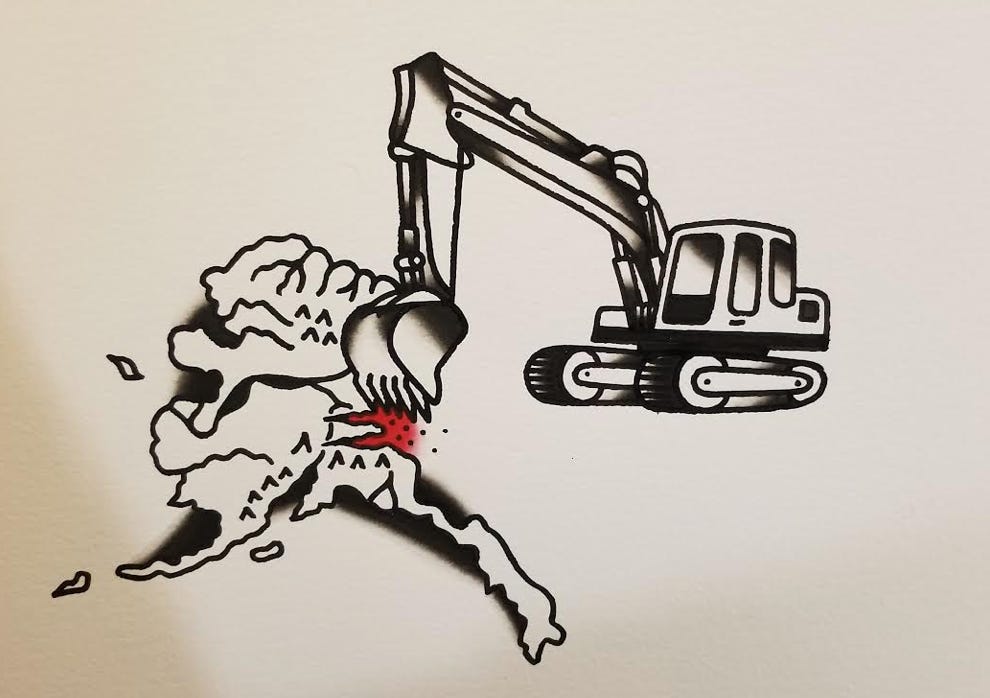
And because of the mid-term election results, Congress republicans continue to do Trump’s bidding by rushing to legitimize such corruption and further consolidate his power before Democrats take their seats in January. One such strategy Republicans are pursuing, is the Bipartisan American Affordability and Jobs Act of 2026 (BAAJA), a federal land and water use permitting reform bill introduced Sens. Martin Heinrich, D-N.M., and Mike Lee, R-Utah, that is clearly a compromise by weakened Democrats. According to environmental journalist Bill McKibben, the bill was “fashioned as a grand bargain that would give both Big Oil and Biggish Cleantech some of what they each want, essentially by making it much easier to build stuff: electric transmission corridors, gas pipelines, you name it.”[2] High Country News says the “legislation is sweeping in its proposed changes, affecting core environmental laws well beyond NEPA, like the Endangered Species Act, Clean Water Act and National Historic Preservation Act. The permitting reform is meant to speed up industry’ s ability to build mines, wind turbines, solar arrays, data centers, pipelines, and more on federal lands.”
Specifically, BAAJA would:
Significantly limit or outright eliminate requirements under the National Environmental Policy Act, the National Historic Preservation Act, and the Clean Water Act, giving the President virtually free rein to award all federal loans, loan guarantees, and other forms of federal financial assistance without transparency or meaningful review;
2. Insulate the Administration’s actions from lawsuits that are currently the only check on Trump’s abuse of power by making it harder for environmental and tribal organizations to obtain meaningful relief from the courts. This includes, in some cases, prohibiting judges from issuing injunctions or vacating decisions, which are the only means of stopping destructive land and water abuse activities resulting from federally sponsored projects.
3. Include certain provisions exacerbating the lack of judicial review by making agency permitting decisions irrevocable with very limited exceptions;
4. Prohibit consideration of new information and science, while significantly increasing deference to federal agencies in defining the scope of review, thereby replacing science and other information such as Traditional Native Knowledge with the political whims of the executive office;
5. Effectively eliminate state and Tribal authority to impose conditions on federal licenses and permits under the Clean Water Act and waive Endangered Species Act and National Historic Preservation Act compliance forissuance of nationwide permits;
6. Eliminate the prerequisite that federal agencies consult with tribal nations about cultural sites at risk of damage from projects, further distancing tribes from federal decision-making on their ancestral lands and limiting Tribes’ options projects violate their rights.
Also, much of the rationale for this legislation is self-inflicted by the Trump administration. Permitting delays, for example, stem from the administration’s dramatically underfunded and understaffed federal resource agencies. Also, Congress has already updated NEPA with deadlines that substantively reduce permitting times. Similarly, the Trump administration negated President Biden programs that made substantial improvements to permitting, including increasing resources that accelerated permitting timelines. Finally, while proponents similarly argue that the bill will cut down on litigation, in reality less than one-quarter of a percent of NEPA decisions annually end up in court.
Abigail Dillen, president of EarthJustice sums it up by stating that BAAJA would be like handing Trump a “loaded howitzer.”
The good news is that, thanks to the mid-term elections, there is a chance to kill this terrible legislation. According to Bill McKibben, this week’s mid-term elections resulted in:
…the biggest single shift in political power in this country since the post-Watergate year of 1974. We don’t know all the factors that drove that great victory—disgust with the Trump regime above all, I think. But one distinctive factor was revulsion at data centers. People had many reasons to oppose them, from water use to energy prices to fear of AI to disgust with oligarchs. But they had only one way to oppose them: the set of laws BAAJA sets out to sideline. There seem to have been forty ballot measures around the country to restrict data centers, and 39 of them appear to have passed.[3]
Until the midterms, Democrats have been negotiating the BAAJA from a position of weakness. Now that they have the upper hand, they must not rush to surrender America’s bedrock environmental protections and Tribal sovereignty to the fossil fuel, AI data center, and extractive industries intent on looting public resources for profit without regard for the consequences. In fact, Dems have a chance to stop what McKibben calls “the most sweeping environmental/energy bill in decades,”[4] on Nov. 9th. by demanding a hearing and amendments to improve the deeply flawed bill before it moves forward. Similarly, especially Lame-Duck republican congressional republican leaders may no longer fear Trump’s bullying and may be less inclined to rush through BAAJA or simply not show-up for the vote.
Please take action today by calling or emailing your senators and ask them to oppose the permitting reform bill using the table below.
For Alaska:
Lisa Murkowski:(907) 271 - 3735; https://www.murkowski.senate.gov/contact/email
Dan Sullivan: (907) 271-5915; Email Dan - Senator Dan Sullivan
[1] Heather Cox Richardson from Letters from an American (November 4, 2026)
[2] Post-wave Politics, Permitting reform in the froth of the tsunami (November, 7 2026) (Post-wave Politics).
[3] Post-wave Politics
[4] Ibid.