

“When we hear his call, we hear no mere bird. We hear the trumpet in the orchestra of evolution.”
~ Aldo Leopold from A Sand County Almanac
The first flush of golden leaves on the birch trees and the marshaling of Sandhill Cranes connote the arrival of fall in South-Central Alaska. The birds, some 600 all told, gather late in the day in rolling fields, restless and jumpy ahead of their departure. For now, the skies still reverberate with their raucous call. But soon, in advance of the first fall tempest, they will spiral up and depart en masse, leaving bittersweet silence in their wake, as we ready ourselves for the onset of winter.
A flock of Cranes is called a Council. Among Alaskan Natives, Sandhills are said to teach patience and offer spiritual guidance. I know something about that. In my ongoing attempt to practice meditation, I was, on a fall afternoon much like this one, coached by a Sandhill Crane.
Sitting in silence among my fellow meditators, I struggled to still my mind and focus on my breathing. My leg cramped, my nose itched, and my mind bounced from one thought balloon to the next. Surely this meditation session would end soon. But no, it dragged on, and on. Opening my eyes, I looked to the left and right, observing the stillness of my Sangha family. Eyes closed, hands cupped, legs crossed, steady deep breaths – calmness prevailed. Argh. Was I the only one who couldn’t let go of my monkey mind and just be? And then I noticed the Crane, moving slowly and gracefully just outside the full-length window.
Standing three feet tall, with a wingspan of six feet, Sandhill Cranes are the largest game birds in Alaska. They are a smoky gray upon arrival in the spring, but soon paint themselves with iron-rich mud as camouflage against predation by Bald Eagles, which share their preference for fields and marshes. Their bugling call, which brings us out of the house in late April to scan the skies for their return, is due to their uniquely shaped windpipe which folds back on itself like a saxophone. If that call seems prehistoric to you, it is. In fact, a fossil of a windpipe found in Nebraska, where they gather along the Platte River Valley by the hundreds of thousands each spring, which has been carbon-dated to 2.5 million years ago.
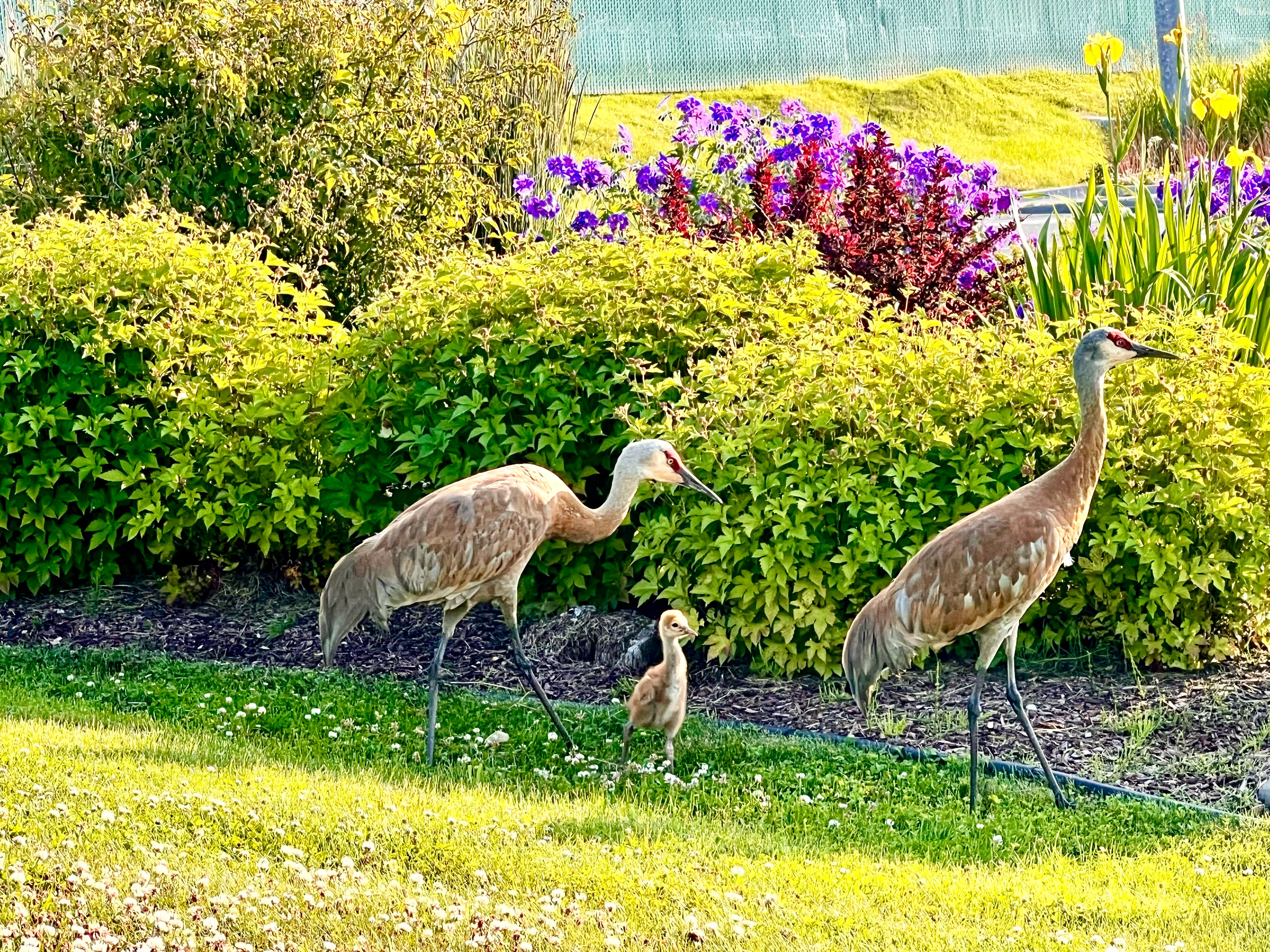
Chicks, called colts, are precocial, meaning they are born fully feathered and able to toddle or swim after their parents within hours of birth. Adults usually hatch out two colts, but often lose one or both to predation. Those that survive learn to grub out roots and eat berries, but also how to catch frogs, insects, and voles. They grow very quickly, reaching adult size in about 70 days. And they learn to dance.
Paired for life, adult Sandhills (sporting red crowns which the colts lack) will engage in an elegant, flamboyant dance, leaping several feet into the air on stilt legs, quick-stepping in circles with their wings open, and bowing while calling back and forth. Not contained to the mating season, this spontaneous display of joy can happen at any time of year.
Focusing on the lone Sandhill outside the window, I watched as she prodded the grass for insects. When her leg needed extending, she reached it out and gave it a luxurious stretch. I did the same, moving so slowly I made no noise. When she tipped her head back and bowed it down, I imitated her, relaxing my muscles and focusing my attention on her movements for the remainder of the meditation. She demonstrated ease and calm, without unnecessary movements, and was in no hurry to get somewhere else. She stayed throughout the hour-long meditation, a patient, if unknowing, teacher. Perhaps she was a Zen master in a former life.
To learn more about Sandhill Cranes, check out Kachemak Crane Watch, produced by Homer Crane expert Nina Faust in conjunction with the Center for Alaska Coastal Studies.
Thanks Sarah! Every day they’re still here is a good day, but I’m sure they’ll be circling up soon to head to Texas. Let me know when they get there - I’m curious!
Jessica
And check out the Author’s book “A Place for the Birds” about the history of Creamer’s Field- a Sandhills Crane sanctuary in Fairbanks.