

You know, somebody has to be alert all the time. We must watch Congress daily. The Arctic National Wildlife Refuge is in such a precarious position right now, politically. All some people can see in these lands is oil, which means money, which translates into greed.
~ Margaret Murie in conversation with Terry Tempest Williams, circa 1996.
The tiny Cessna 185, loaded with field gear, threaded through the White Mountains north of Fairbanks, Alaska. Above a sparsely wooded slope, Pilot Mike Vivian tilted the plane and pointed out a large brown bear in a clearing below, the first I had ever seen. There was no point in talking over the engine’s growl, and I just nodded with enthusiasm. We continued north above stunted black spruce until the Yukon River came into view. At some point, we crossed an invisible boundary into the Arctic National Wildlife Refuge. Mike banked right, and we followed the wide river northeast until we reached the mouth of the Porcupine River, one of the Yukon’s larger tributaries. Observing its braiding, snaking channel below us, I had the impression of a land as old as time, unspoiled by human progress.
The year was 1993. I had driven up from Arizona for a seasonal job with the US Fish and Wildlife Service. New to Alaska, I was keen to see the arctic and experience first-hand this remote and storied wilderness.
When the Porcupine River narrowed into a canyon below us, Mike eased back on the throttle and began to descend. He flew low, watching the river until he spotted a red Zodiac pulled up on shore. We made out two people climbing the steep bank, working their way toward a peregrine nest near the top of the bluff. They waved in recognition, and Mike waggled the wings in reply before making a tight U-turn and heading back downriver a few miles where he brought the plane in for a rugged landing on a long sandbar. The engine died, and Mike popped open his door.
“This is it. I’ll drop you here with your gear. The crew should be along soon.”
I climbed out, relayed equipment from the plane to a clearing above the beach, and held up a hand in farewell as Mike roared off. The engine’s whine remained long after the plane became a pinpoint and vanished, until only a great quiet remained. I looked around, taking in the small pile of camping gear, a shotgun for bears, the crumbling canyon walls, and the swollen river. I had never been so completely alone. A thrill of pleasure laced with trepidation ran through me.
Within the quiet, wind stirred the grass. A Savannah sparrow flushed, giving me a start. Insects droned—bees, mosquitoes, a brilliant blue dragonfly. The cloudy Porcupine River, laden with silt, shushed in her banks. I climbed the bluff to gain perspective and took in a mosaic of low spruce, alders, and grasses, and the ragged Brooks Range beyond. A trail ran along the bank, and I followed it upstream until I saw scat tufted with fur. Wolf. Realization dawned, along with a prick of unease—this trail was not man-made. I headed back to my provisions (and the shotgun), pulled out an apple, and sat down to take in the solitude and wait for my ride.
True to Mike’s words, the Zodiac rounded a bend about an hour later and made for the shore where I sat. Fran Mauer, a biologist with the Arctic Refuge, and Frank Keim, a volunteer with years of experience on the river, pulled the boat ashore and came over to introduce themselves.
“Ready to get to work?” Fran asked. He was a slight man with thinning hair under a red climbing helmet. Dressed in tan pants and shirt, and leather boots scuffed with wear, his manner was friendly yet professional.
“I am!” I answered, then handed my backpack and gun to Frank, who had already busied himself tying down the fat dry bag of food I’d brought along.
“There should be a nest on the far side,” Fran gestured, and pointed a short distance downriver to an area of whitewash where the adults often perched.
Tying up the Zodiac, we climbed the bluff while two peregrine falcons swooped above us, calling out a resonating “kee-kee-kee”. They were not happy with us. From the grassy top of the bluff, Frank worked his way down to the nest – a sheltered cavity in the rock face.
Between eighteen and twenty-eight days old, the chicks glared at us, hissing, gray and pink mouths open wide in alarm. They still had their downy feathers, but spiky brown wing and tail feathers were coming in. Frank handed the first chick up to me and I gripped the warm bundle with both hands, carefully avoiding his beak and needle-sharp claws. I could feel his heart thrum against my palm. His eyes were wells of black with blue pupils, and I had the uncanny sense he could see into my soul. Then I handed the chick to Fran for banding and reached down to Frank for the next one.
The Porcupine River winds with a lazy sinuosity at four or five miles an hour through the Arctic Refuge. Two expanses of canyon walls, called the Upper and Lower Ramparts, provide the highest concentration of peregrine nests. This is where we focused our search as part of a study that had been ongoing since 1979.
Peregrines are crow-sized falcons. Their slender wings are designed for remarkable speed and agility. Clocked at speeds of 240 miles per hour during dives, they are stealthy hunters. They may climb several hundred feet into the air to observe the river below with their keen eyesight. Then, prey spotted, they fold their wings and hurtle earthward, striking their target and often recovering from the dive in time to snatch the stunned bird before it hits the water. Their free fall makes an eerie sound, like a tiny meteorite whistling toward Earth.
As with most hawk species, female peregrines are larger than the males. Adults have slate-blue wings and dark-gray backs, creamy bellies with horizontal barring, and a distinctive black hood and sideburns on white cheeks.
Peregrines, along with other raptors including the American bald eagle, suffered dramatic population declines in the 1960s and ’70s due to the use of organochlorine pesticides like dichlorodiphenyltrichloroethane (DDT). Used extensively for pest management on crops in the United States and Mexico, the pesticides accumulated in the animals’ bodies in greater concentrations as they worked their way up the food chain. Peregrines primarily eat smaller birds, like pigeons, which ingested DDT in the grains they consumed. High DDT levels resulted in the formation of thin eggshells which were easily crushed during incubation.
In 1970, both the American peregrine falcon, Falco peregrinus anatum, and the Arctic peregrine, Falco peregrinus tundrius, were listed on the federal register as endangered. Only the Peale’s peregrine population, Falco peregrinus pealei, remained stable. Being coastal birds, Peale’s don’t generally migrate and were not exposed to high toxin levels. DDT was banned nationwide in 1972, paving the way for a peregrine falcon comeback.
Fran explained, as he handed up a second chick, that the peregrines on the Porcupine were now recovering. The more favorable nest sites were all occupied, and younger birds without an established claim to a nest made do with more exposed sites. That summer, the survey tallied 30 nesting adults, and 49 chicks banded, plus a half dozen subadults.
Peregrine nests are rudimentary, consisting of a hollow within a rocky cliff or an abandoned stick nest left by an eagle or hawk. Devoid of down or soft grasses, they contain the bloodied bones and feathers of small birds the parents bring for their young. Each nest typically holds two or three chicks and sometimes as many as five.
Ever watchful of the parents who circled just overhead, we handled each chick only briefly before returning them to the nest with a silver band bearing a unique number. These bands, if collected from a dead or captured bird, would provide the year and location of their birth. Birds banded on the Porcupine River have been recovered in North Carolina, Florida, Mexico, Brazil, and as far south as Argentina. It’s fitting that the name peregrine, from the Latin Peregrinus, means “foreigner” or “traveler.”
We made camp as the sun hugged the horizon. It was after ten o’clock, but this far north, in July, the sun never sets. Downriver from a peregrine nest, we were close enough to observe the birds yet far enough away not to disturb them. We watched them hunt cliff swallows, which also nest along the Ramparts. One swallow, in desperation, dove below the water’s surface to avoid capture. The peregrine, waiting on the wing, swooped down and snatched it up after it resurfaced for the third or fourth time. I couldn’t help but think of his tiny bones littering the peregrine’s nest.
Back on the river the next morning, we sat on the Zodiac and drifted, listening and watching for peregrine. There was minimal boat traffic, never more than two or three boats a day. That morning, we’d met a German couple as we prepared to break camp, and later, drifted past them as they sat naked in their tent. Most of the boats we saw were operated by state or federal employees, and Fran and Frank introduced me to everyone we met. There was camaraderie among these people who devoted their careers to wildlife and wild rivers.
We banded chicks from two or three nests per day, depending on how difficult they were to reach. Sometimes we climbed the steep slope, and Fran, in his helmet and leather gloves, rappelled a few yards down, then handed up the chicks to Frank and me to band. At other times, the nests were easy to approach, and we squatted nearby with our banding equipment.
On the river, we were treated to sightings of Pacific loons, their long, silver necks gleaming in the sunlight. The sound from the boat motor flushed them up and they flew away from us, low across the water, in twos or threes. We also startled large flocks of Canada geese. These were molting birds, unable to fly until their wing feathers grew back. Vulnerable to predation, they vocalized their alarm and hurried awkwardly toward the shore where they hid among the sedges, water churning around them.
On the third evening, as we motored toward camp after our final nest of the day, Fran pointed out a black bear sow and her yearling cub swimming across the river up ahead. Another cub, already on shore, called impatiently for her and scampered back and forth. The sow hauled herself from the water, shook the moisture from her head and shoulders in a great spray, and ambled into the brush to join her cub. The second cub made its way onto shore and ran bawling to her, throwing a worried look in our direction. We were now within a hundred yards, idling the boat engine. This cub was a cinnamon black bear, the only one I’ve ever seen. His coat was red-brown with a golden cast, evident even with water streaming off. Together the bears moved into the willows, dissolving into the tree line as we motored past.
On the last night of the trip, as we readied our campsite, the drone of an engine caught our attention. It was another Fish and Wildlife Service pilot, Roger Kaye, here to retrieve me. But rather than expecting me to pack for the return flight, his door opened, and a sleeping bag thudded to the ground, followed by a tent. We helped him secure the plane, built up the fire, and added more noodles to the pot.
Late into the evening, as the fire popped and sent sparks into a sky that would not grow dark for several more weeks, the men talked. New to Alaska and to this way of life, I took it all in, appreciating the opportunity to hear their perspectives.
Roger, smoking a cigar that drifted a pleasant tobacco smell my way, talked about the Arctic Refuge as if it were, like the peregrines, on the threatened and endangered list.
I didn’t understand. “How could anywhere be wilder than this?” I asked him, gesturing to imply the river and the Arctic plain beyond.
“The wilderness isn’t what it used to be,” he said, prodding the fire with a stick. “Transmission towers are going up, along with dozens of new airstrips, and now, with aerial images, you can plan out everything before you ever leave home. It takes the adventure out of traveling in the Arctic. We’re losing what it means to be wild.”
“People don’t want true wilderness. They want safe adventure. If they get into trouble, they can use a satellite phone to call for help. And in ten years, or twenty, we may lose even that watered-down version of wilderness. The oil companies are pushing to open the Refuge to oil development. If they get their way, there will be roads, and pipelines, and pump stations the length of the coastal plain.” Fran added.
“The tundra is fragile,” Roger continued, speaking in earnest now, willing me to understand. “It doesn’t heal in ten years or a hundred. Any development footprint we leave here will irreparably change this place.”
I considered this. What I had thought of as a protected wilderness was, in fact, threatened. The battle to keep it wild and undeveloped might protect this pristine corner of Alaska for a time. Yet one act of Congress could bring about a change that would forever alter the health and continuity of this landscape.
The following summer, in 1994, I moved to Alaska permanently and returned again to the Porcupine River to band peregrines. That year, the Fish and Wildlife Service removed Arctic peregrine falcons from the endangered species list due to their rebounding population. In 1999, I cheered the additional delisting of the American peregrine falcon. We had done right by them in removing toxins from their wintering grounds. But would we continue to do right by keeping their nesting environment and the rest of the Arctic Refuge intact?
Now, 33 years and half a lifetime later, the Trump administration is paving the way for oil drilling lease sales that would open the entire 1.56-million-acre Coastal Plain, which makes up the northern edge of the Arctic National Wildlife Refuge. If he has his way, four sales mandated by his “One Big Beautiful Bill” would parcel off in tracts of at least 400,000 acres to drilling, road construction, miles of pipeline, tailing ponds, and man-camps.
Unfortunately, protection for the Coastal Plain was not included in the 1980 wilderness bill, leaving Congress to decide its fate, and in 2017, during the first Trump administration, Congress authorized opening the area to oil leasing.
One can only hope this auction will fall as flat as the 2021 lease sale which yielded no bids by major oil companies. The lack of interest was due to low oil prices and the high cost of developing such remote fields, and to public outcry, and the uncertainty of lease validity under constantly shifting political will. The only bids came from the State-sponsored Alaska Industrial Development and Export Authority, and one small oil company, which later withdrew its bid. But putting virgin land, some would say, hallowed grounds, on the auction block is Trump’s way of thumbing his nose at environmentalists who value wilderness even when they may never personally set foot there.
No drilling, other than one test well, has occurred on the Arctic Refuge, despite decades of political wrangling. The findings have never been made public, and interest by oil moguls has been lukewarm. And yet the push for drilling continues to drive lawsuits by the Gwich’in people of northeastern Alaska and Canada. Their connection to this land is utterly integral to their spiritual and cultural identity.
“It is easy for people to understand the intimate connection between a mother and child. This may be the easiest way for people to understand the Gwich’in connection to the Porcupine Caribou herd. It feeds our heart, mind, body, and the soul of the Gwich’in Nation and has done so for millennia.”
~ Chief Dana Tizya-Tramm
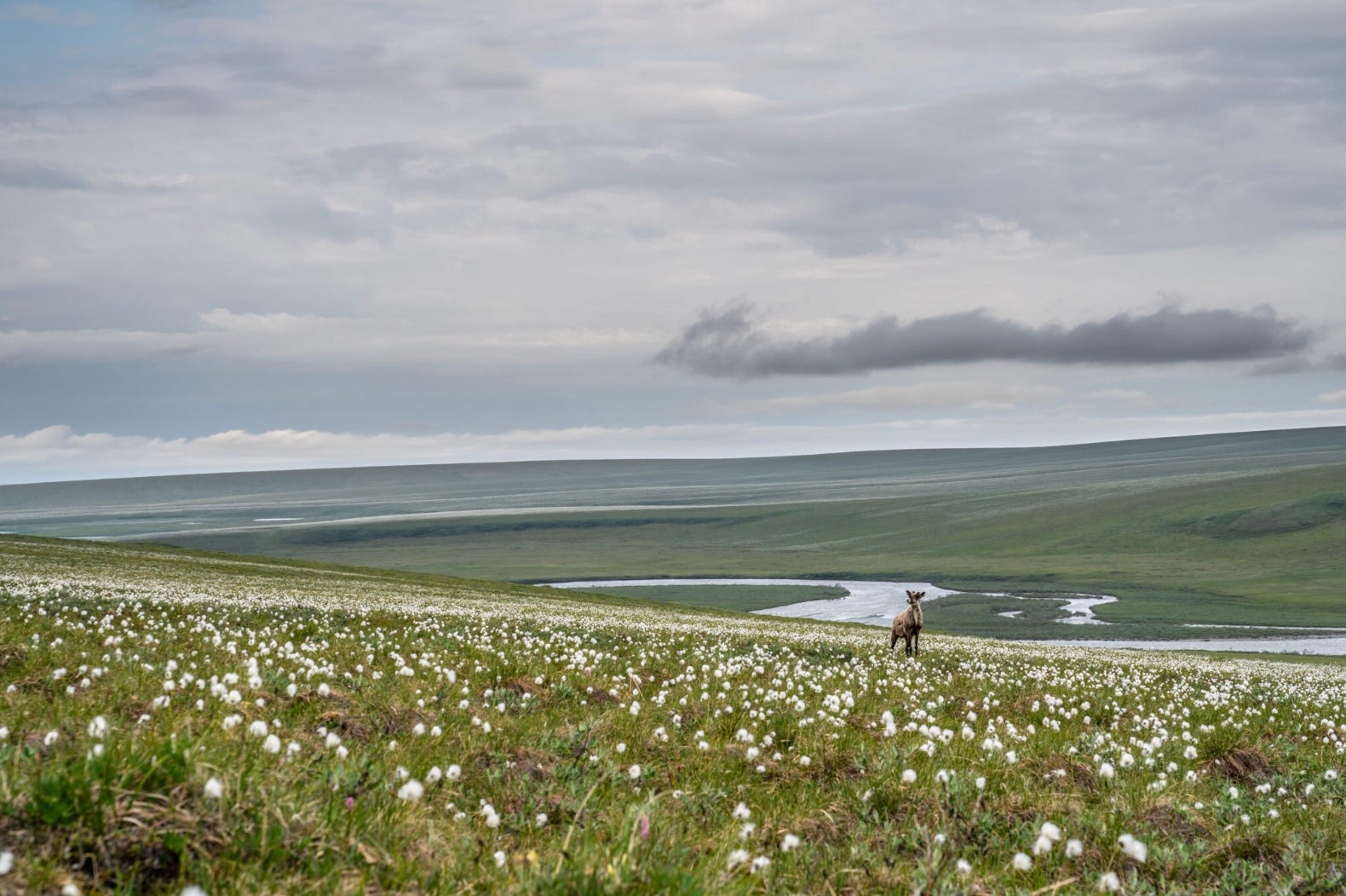
The Porcupine Caribou Herd, which is in sharp decline, calves on the Coastal Plains. The population count was 143,000 as of July 4, 2025, down from 218,000 during the 2017 photo census. This decline is due, in part, to the freeze-thaw of snow during the winter months as the climate continues to warm. Brief periods of above-freezing temperatures encase the lichens that make up the bulk of their winter diet in ice. Meanwhile, Trump’s push to open the Coastal Plains to oil and gas flies in the face of climate science which indicates that the Arctic is warming four times faster than the global average.
For now, the Arctic National Wildlife Refuge remains timeless, feral, windswept – free from all trace of modern man, save for the occasional overflight of an airplane, departing after disgorging a small party of river rafters. There are no roads, no communication towers, no pipelines, just an expanse of wilderness from horizon to horizon, with an abundance of wildlife, and a small enclave of tenacious Native people who are integral to this challenging landscape.
But change will come, with or without oil development. As summer temperatures approach 90 degrees and, despite the full embrace of darkness, winter temperatures breach freezing, tundra fires will increase, the ice lining summer ponds will melt, allowing the water to percolate away, oceans will rise and consume the shoreline. Still, the caribou will wander, birds will arrive each spring, and Natives will adapt as best they can, given the chance.
I think my main thought is this: that perhaps Man is going to be overwhelmed by his own cleverness; that he may even destroy himself by this same cleverness; and I firmly believe that one of the very few hopes left for Man is the preservation of the wilderness we now have left; and the greatest reservoir of that medicine for mankind lies here in Alaska.
~ Margaret Murie speaking before the Alaska Humanities Forum, 1990.
Thanks Teresa, It does feel personal after having been there and seeing for myself how big and embracing the Arctic Refuge can be. Have you read Margaret Murie's Two in the Far North? What a life she had, and what an advocate for all places wild. Rereading her book after 30 years is what prompted me to revisit this article I'd written probably 20 years ago.
We’ve never floated the Porcupine, but have seen plenty of Peregrines. They are splendid, so is your writing.