

Summers in Alaska are achingly short. Bookended by the ruckus of Sandhill Cranes during late April’s thaw, and their melancholy departure as rain turns to sleet in early September, we get four months of warmth, at best. This summer, after a cold start, we hit the ground running, building new garden boxes for the upper garden, and plunking a 1,500-gallon-water tank in the center of the lawn to replace our spring (which failed in March’s deep freeze, never to recover) with a promise from our handy neighbor Eivin to enclose and plumb it before freeze-up returns.
While Hal flew away on one of his bi-weekly field trips to Nome and the Great Beyond (otherwise known as Norton Sound), I planted the high tunnel and new garden boxes, and enjoyed an afternoon boat ride to Halibut Cove and a light repast at the Saltry Restaurant with friends Marjory and Rick. Mid-month, I drove our R-Pod trailer up to Fairbanks, meeting Hal there, to promote my new book A Place for the Birds at the Creamer’s Field Wild Arts Walk, and saw several longtime friends. Later that week, the granddaughter and I took ourselves out to the Spit when the tourists weren’t too bad and enjoyed Swift Tacos (deep-fried Avocado) and Carmon’s Gelatos (Chocolate). Hal flew back north, boating to and wading through boggy tundra to measure the depth and width and flow of pristine alpine creeks ahead of a proposed, and vast, graphite mine. On his return, we spent three days at the Palmer Scottish Games, and the next weekend, squeezed in a family camping trip at Johnson’s Lake.
July rolled in, and it was time to put up fish. We got up very early on a rainy Saturday and took Alan’s first water taxi of the day to China Poot, riding the high tide in. There, we traded our one dip-net back and forth, limiting (six Reds each) before breakfast. We snagged a few more, further downstream, and with time to kill before our boat returned, we hiked to the upper falls. Clambering over slippery rocks and wading through churning water, I wondered, not for the first time, how many more years I’ll be able to do this. The canyon narrows, and a torrent of water spills over granite boulders from a height of perhaps 40 feet. In the churning cauldron of water at the base of the falls, a glut of Red Salmon teamed. Several hundred at a guess, taking turns throwing themselves upward in an attempt to scale the torrent. Their efforts are futile, as these are hatchery-raised salmon, and this is a terminal run capped by the falls.
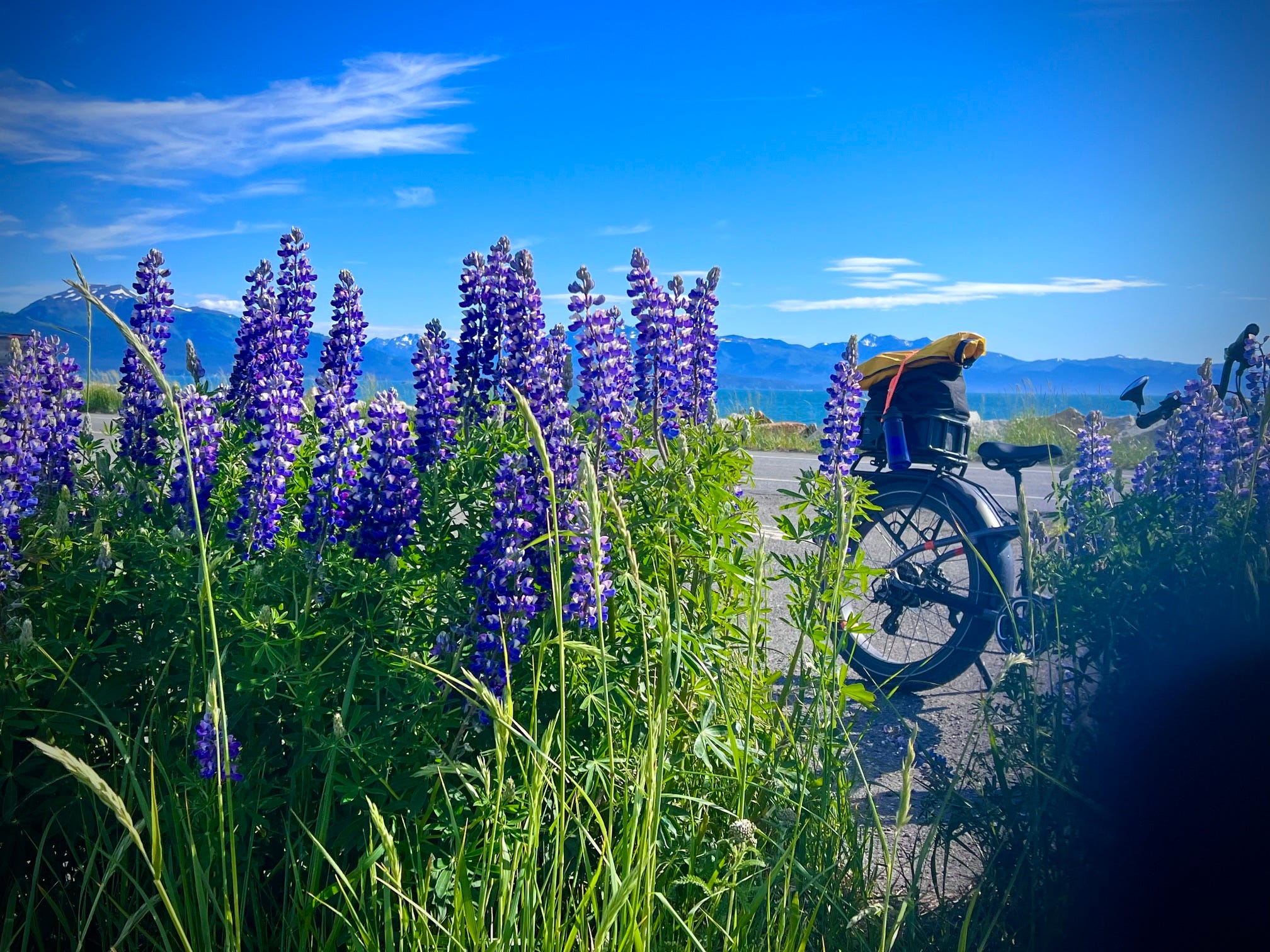
The next day, we took our annual lupin bike ride along the Homer Spit. The endless hedgerow of lupins was at its bluest, and yes, it was a sunny day, making them radiant against Kachemak Bay and glinting glaciers. Prettiest place on Earth. We stopped at Cole Point Fish Processing, and packed panners and bike bags with our flash-frozen, pan-ready fish before wobbling with our heavy loads back along the Spit to the car.
Hal went back out the next weekend with our neighbor John and limited again, netting us, all told, about 25 salmon, or 100 fillets. Enough for the year and to share some. He headed back out to the field, and I joined friend Donna Rae for a Fast Ferry ride over to Seldovia for a day of sun and scenery. How good to catch up with a girlfriend as we sauntered through that quaint seaside town.
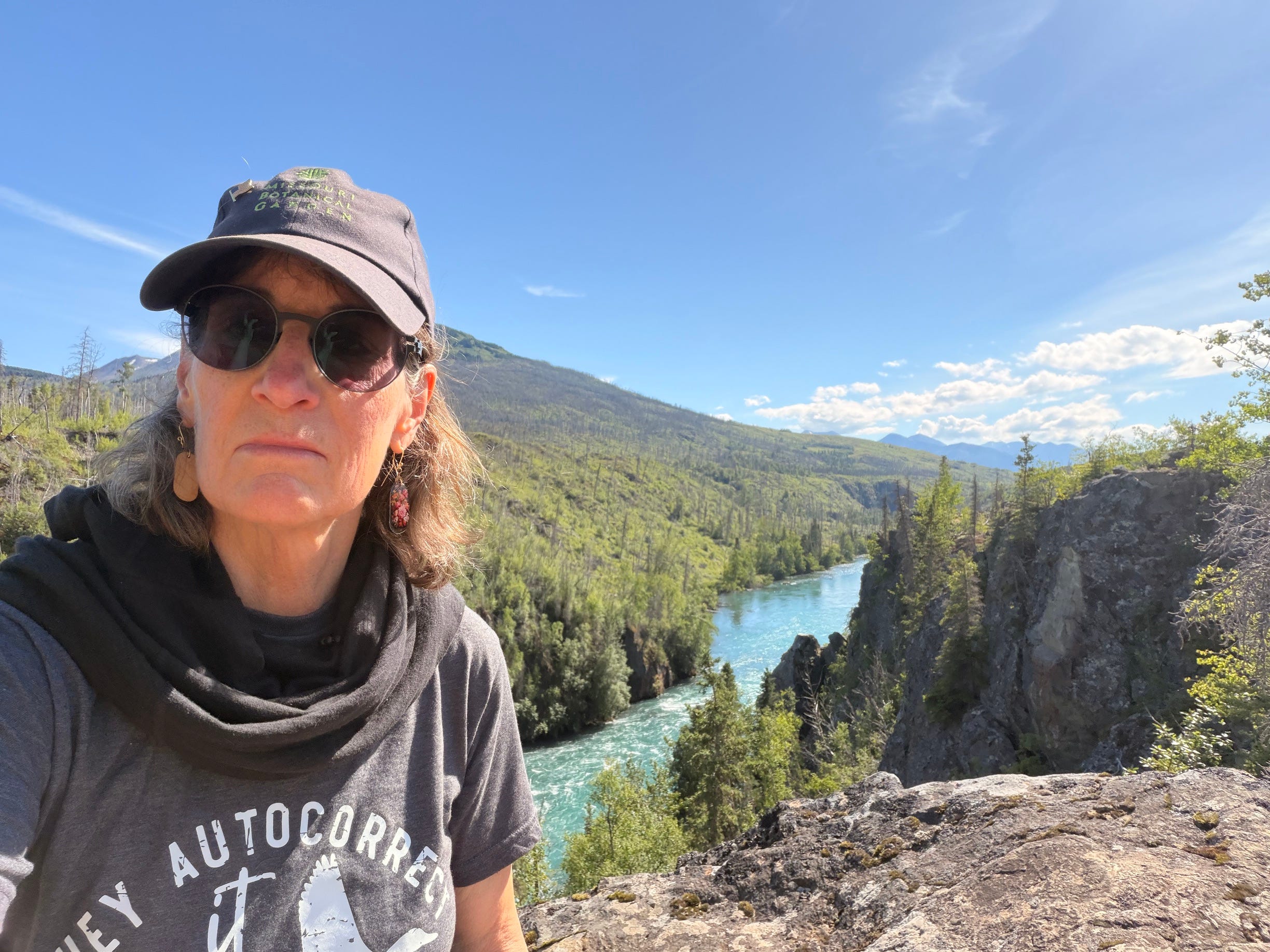
At the end of the month, Hal and I set out on our annual three-night camping trip to Hidden Lake on the Skilak Lake Road, beginning with a night at Johnson Lake where we paddled among lily pads fishing (but no catching). Near Hidden Lake, Hal spent a couple of hours plying the upper Kenai River along with the 20 or so fisherfolk (women and kids too) belly-deep in their chest waders (more fishing but no catching), while I hiked the winding trail up to the view of the canyon. This has become a favorite short hike, with a birds-eye view of blue-green waters surging between granite walls – the Kenai River’s last hurrah before it empties into Kenai Lake. I’d like to be a Peregrine Falcon on this stretch of river.
With so much to fit in during these long but limited days of warm(ish), often wet weather, we struggle to impose a balance between chores, work, and play. We missed the window for our annual paddle from Kiltcher Beach to Chugachik Island due to heavy chop in the bay, and the list of outside chores is still growing, not shrinking. But when you have an unplanned opportunity to water taxi across Kachemak Bay into Little Tutka Bay for two nights at the Sea Star Cabin, you set aside a few things and go. My dear friend and neighbor Melisse had won the trip at a Friends of State Parks fundraiser, and would I like to go?
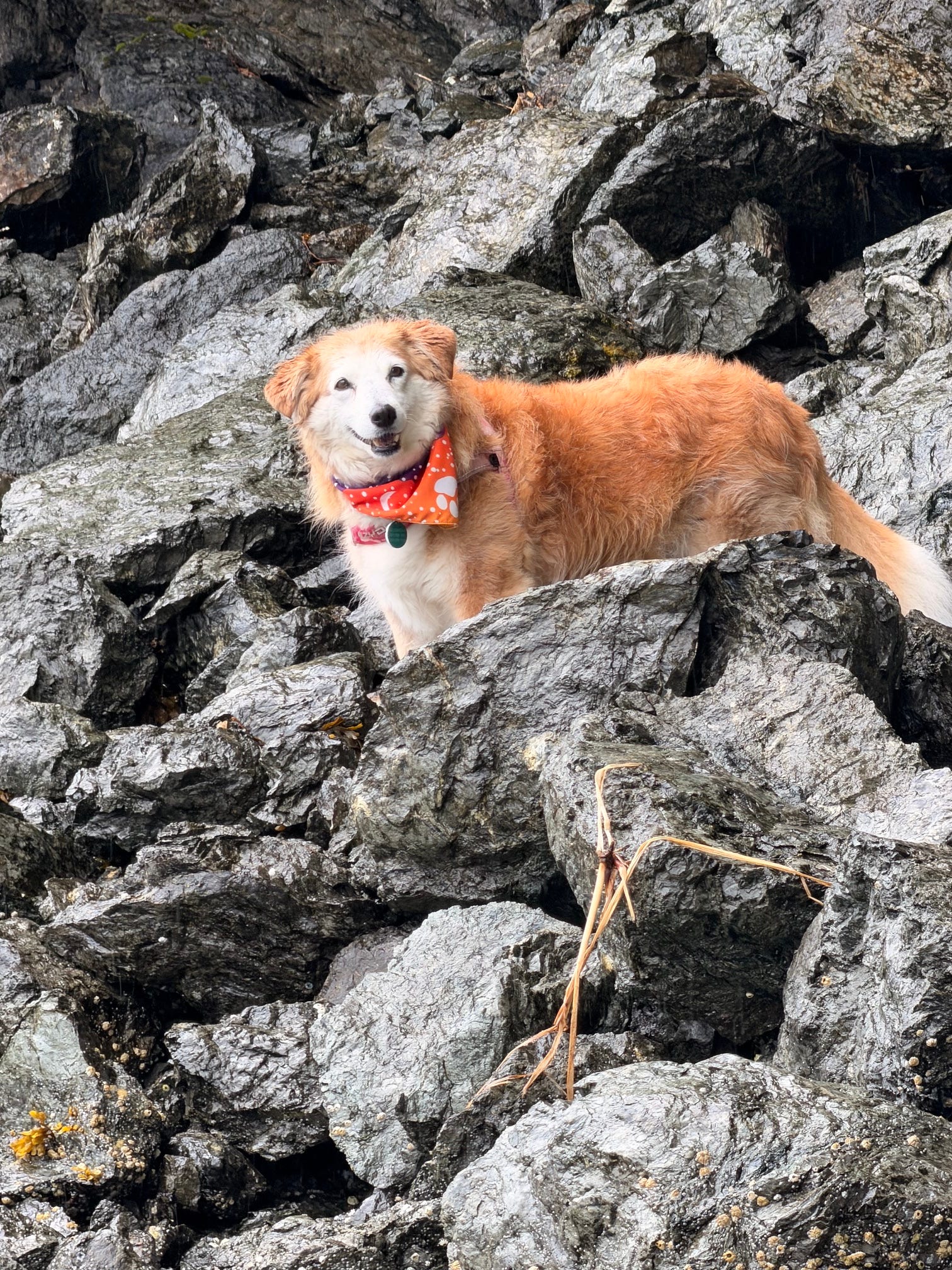
Seaside cabin, at the far end of Little Tutka Bay, is your basic State Park log cabin, with a wood stove, bunk beds, and an ample wooden table and benches inside, a covered deck with a view of the bay, and an outhouse behind. The first night, knowing we were due for rain the rest of the trip, we enjoyed a cheerful campfire with our four-legged companion and “sweetest girl”, Georgina. Four seiners plied the water for salmon at the mouth of the bay, while near us, the fish rose and splashed with regularity. An Eagle chortled, and several Pacific Crows made noisy forages over the beach, along with a few Mew Gulls, glowing white in the low angle of the sun. Hermit Thrush, mostly silent now that mating season had passed, flitted among the low branches, while a juvenile Rufous Hummingbird circled us repeatedly, moving from branch to twig, to stim, to hover, clearly curious and likely drawn to the red in our clothing.
On a short solo kayak, I breathed in the briny smell of ocean and rain-saturated Earth tinged with the woodsmoke from our fire. Paddling along the west side of the bay, I flushed a family of 10 Common Mergansers before peeking into Tutka Bay Lagoon. The rising tide wanted to pull me in, and I wanted to let it, but prudence won out, and I turned around to find that a headwind had picked up, making the return a bit challenging.
We woke to rain on the cabin’s metal roof. It was dusky within, but never really dark outside, with enough light at night to illuminate the roots crisscrossing the path to the outhouse. The cabin is nestled in a cove facing north-west, giving it the full advantage of the sun’s northerly angle. Come winter, this will be a dark, wet place until snow brings brightness to this quiet coast. This is an area of old-growth forest. 100-foot-tall spruce are well spaced, with lower branches supporting large mossy forms in the shapes of animals and birds, depending on one’s imagination, giving the forest a whimsical air. The understory is made up of Devil’s Club – showy with their big, lobed leaves, but limiting travel to a network of paths.
We knew there was a trail from the cabin to Tutka Lake, and on our first afternoon, we searched each wandering path around the cabin until it dead-ended amid a tangle of Devil’s Club and deadfall. The next day, despite the rain, we climbed over and around boulders along the coast in search of an access point until Georgina, winsome soul that she is, sat down and conveyed, “Enough. You two old broads may not have enough sense to turn around, but I do.” True enough. There was Melisse, recovering from a broken wrist, and me with my nine toes after foot surgery, but determined to have our adventure. Bowing to her wisdom, we followed her lead, and I for one was glad to reach the easier walking of the gravel beach below our cabin as the rain picked up.
On a second solo paddle, I went east on rain-dappled water with jellyfish undulating below the surface all around me. Paddling the contours of the shore and up into an inlet where a primal creek surged, I was witness to an area unchanged by mankind. I peeked out into the main channel of Tutka Bay, but the surge and tide were stronger there, so I just hovered at the fringe, exploring with my eyes. On my return, Melisse supported my hesitancy to push into those tempting waters, saying “We’re getting to an age when the balance between adventure and caution has begun to shift.”
Melisse and I camped easily together, as if we’d been doing it a long time. And in some ways, we have, with years of Chugachic Island trips together with Hal and Dave. She was in a funk brought on by her injury, and the sense of doom we all feel these days due to political and environmental news. I did my best to cheer her. “It’s true, we’re damaging the Earth and causing rampant species loss, but when we’re gone, Mother Earth, in her fecundity, will flourish on the piles of rubble we leave behind.” It’s our attachment to the animals and places we know and love that cause us grief. But, in time, wondrous new species will arise to replace those we diminish. So too, the true Americans - our sage Native populations - may once again be left to care for this damaged land after the folly of European capitalism plays out. Melisse looked out at the trees and their moss, and imagined that the trees were in a slow-motion dance, too slow for us to see, and the idea charmed us.
On our last morning there, we finally spotted the faintest bit of red flagging and discovered the trail to Tutka Lake at last. The trailhead began at the mouth of the creek flowing onto the beach. Once we made it above the creek, we found the trail to be well established and recently cleared of downed trees, and we climbed up and along the ridge above the bay a mile or so until we reached the lake. Several acres in size and ringed with trees, it was laced with lily pads, like a Monet painting. Rain dotted its surface, hazing the view just enough to enhance it.
Mid-afternoon found us waiting on the beach for the water taxi as the tide receded, revealing mounds of golden popweed and colorful rocks dressed in barnacles. Blue mussel shells littered the sand, and in the bay, the occasional salmon splashed, while our resident eagles gave their teetering calls. Too soon, the V of a boat headed for us, and we gathered our gear and made our way on board and back to Homer. Three days without the plague of news cycles, work deadlines, and doctors’ appointments were a gift only the wilderness can provide.
And now, in a blink, August is half-gone. Already, the Sandhill Cranes are teaching their young to fly in preparation for their lonely departure. Hal and I spent a warm, sunny weekend outside, dead-heading Pushky (cow parsnip) to discourage its spread, harvesting the high tunnel’s first broccoli and cauliflower, mowing the lawn, tossing a Frisbee for the dogs along a lane graced by fireweed blossoms, and grilling fresh salmon for dinner. Then Hal departed for his final trip north. He shared a photo of the supper of moose heart and tongue soup he was gifted by a Native friend (apparently it was really good). Today, as I write, he’s taking a helicopter up to the headwaters of the Kigluaik Mountains with contract biologists from the Tyonek Tribe documenting the presence of Dolly Varden, Arctic Grayling, and Chum Salmon, despite the mining company’s claim that the waters there are too acidic to support fish. I cheer his work. Ahead, we have woodcutting, berry picking, and winemaking. Ah summer. You give so much, awaken us to the best Alaska has to offer, and depart so quickly.