

River-by-River, State-Fed are Taking Apart Alaska’s Subsistence Priority
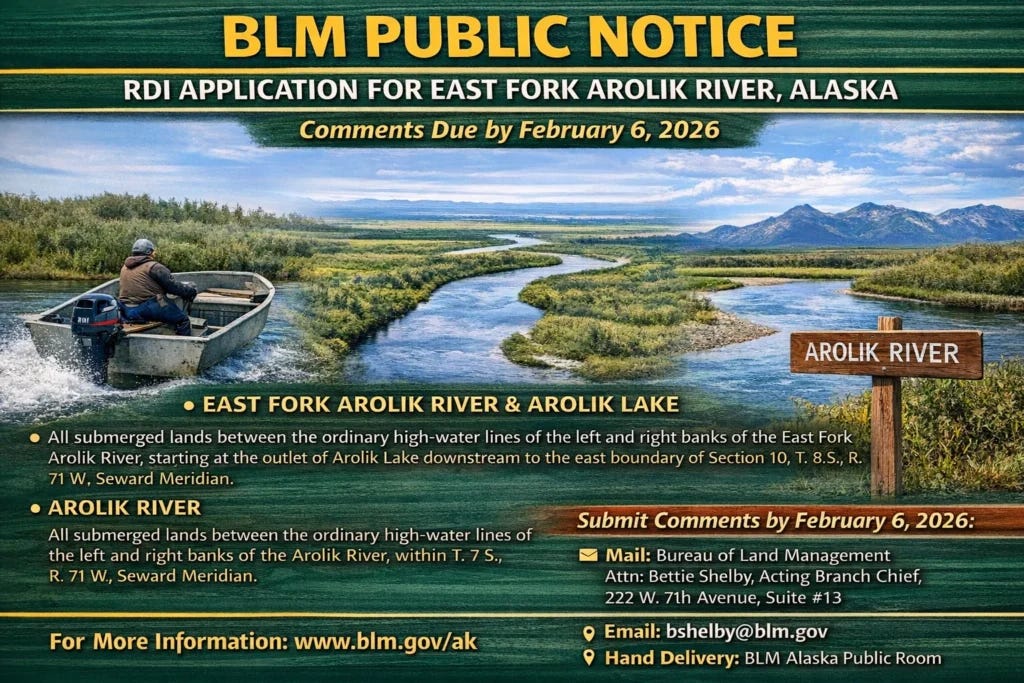
The Arolik River is an ecologically rich waterway flowing through Bureau of Land Management lands from its headwaters in the Ahklun Mountains to the Bering Sea in the Yukon-Kuskokwim Delta region. Beginning in the Ahklun Mountains, it meanders through tundra and shrub willow country before emptying into Kuskokwim Bay near the village of Quinakagak, 70 air miles south of Bethel. The local Yup’ik village community relies on these waters for subsistence harvesting, which support world‑renowned rainbow trout and all five Pacific salmon species (King, Dog, Red, Pink, and Silver), as well as Dolly Varden, grayling, and other cultural and traditional uses.
Yet this river, as well as its salmon populations, is threatened by the state’s continuing efforts to wrest regulatory jurisdiction over it and other rivers throughout Alaska. Back in 2021, Governor Michael Dunleavy announced that the state of Alaska was taking control of navigable waters from the federal government. Stating that the Fed has “dragged Alaska through a costly, multi-year process – for each waterbody – to get what has been ours since 1959.”
The Dunleavy administration believes the process for obtaining jurisdiction over navigable waters on federal lands has been too slow and onerous. As such, the state has consistently sought ways to circumvent the process, especially for rivers targeted by anglers or hunters for trophy-size moose or renowned fishing opportunities.
In August 2025, Nathaniel Herz with the Northern Journal joined so‑called a “Public Access Assertion and Defense Team” — about a dozen Department of Natural Resources employees who traveled to several federally managed lands such as National Parks, Preserves, and Bureau of Land Management areas, in their effort to support what the Dunleavy Administration believes are legal rights to the land beneath the navigable waters of “submerged lands” in these areas.
The U.S. Supreme Court, however, has rejected complete ownership of water by either the federal or state governments, and the law requires the state to make a fact-based determination of navigability for each river before it can assume jurisdiction. More importantly, because state law requires that subsistence fishing be open to all Alaskan citizens, giving the state complete jurisdiction over these waters would eliminate the Rural Subsistence Priority under federal law. Because the Priority limits subsistence fishing to rural residents, it not only protects Alaska Native fishing rights but also reduces pressure on rapidly declining salmon populations. Maintaining federal authority to protect Alaska Native communities’ subsistence preference and prevent increased fishing pressures on these rapidly declining salmon populations is critical, given the effects of climate change and development impacts.
Nevertheless, state officials have met with the Trump Administration to obtain the Department of the Interior’s agreement to relinquish jurisdiction over specific rivers throughout the State. The Journal reported that, according to Jim Walker with the Alaska Division of Mining, Land & Water, “[i]nstead of going through and giving minute details about every mile of these rivers, we talk, rather, about our methodology and why it’s so sound.”
As part of its campaign to roll back federal environmental protection regulations, the Trump Administration is turning over vast amounts of land in Alaska to the state to be used for industrial extraction purposes, threatening fish and wildlife and vast acreages of unbroken landscape.
The threat not only involves land but also rivers and streams. The State’s proposal regarding submerged lands prompted the Trump administration to include language in the Unleashing Alaska Executive Order directing federal resource agencies to transfer regulatory authority over such waters to the State, instead of going through the standard fact-based process for determining State jurisdiction.
As a result, through an innocuous-sounding “Recordable Disclaimer of Interests RDI’s),” the BLM is unceremoniously converting ownership to the State one river at a time. RDI’s which have already been granted or are under consideration by the BLM include the East Fork of the Arolik River, the Arolik River, and Arolik Lake; lands underlying portions of the Delta River;Tangle River; and Tangle Lakes; the Kwethluk and Goodnews Rivers; the Dennison Fork of the Fortymile River, and the Eek River;which are all important subsistence fishing rivers. Additionally, the federal-to-state giveaways will result in a shift in management from the more protective federal standards, including national wildlife refuges, national parks, and preserves, to less protective state aquatic habitat standards.
The Dunleavy and Trump Administration’s piecemeal strategy is to dismantle the subsistence priority watershed by watershed. Alaska has many more RDI applications that the Department of the Interior is still processing. If BLM grants jurisdiction over all of these submerged lands, the implications for subsistence priority and salmon could be dramatic.
Thanks to all the likes on this post. Really appreciate our readers. If you haven't already, don't forget to subscribe if you want to keep up with the latest articles.