

War, Deceit, Empathy, and the Peacemakers
War
As a result of recent events, I have been thinking a lot about the stupidity, insanity, and inevitability of war. I asked myself: Is war a hereditary curse we must endure, or something we can prevent through social and cultural change and increased scientific and educational awareness? We would have to start by understanding the roots of war, and then develop the tools we must use to prevent wars. Wars are instigated by those in power, typically started by heads of state, monarchs, and religious/political leaders who pursue territorial expansion, resources, or political dominance, as opposed to the everyday citizens forced to fight them. These leaders know how to work propaganda on the masses. We seem to have a certain propensity toward gullibility, which may be written into our DNA. However, empathy can overcome it. Empathy is also written into our DNA.
The science seems to be validating this idea with what is happening today, on the world stage, with conflicts in Europe and the Middle East. Nothing fits the social-biological playbook as well as the war in Iran instigated by the Trump Administration. Pete Hegseth, Secretary of War, a classic warmonger, could have stepped out of the pages of Genghis Khan or Ivan the Terrible, given his seemingly orgasmic interest in war. War for the sake of gaining territory and resources, and for the joy of war. Also, invoking the name of God to support what he is now calling a holy war.
Deceit
In his view of evolution, Richard Dawkins, in his landmark 1976 book, The Selfish Gene, argues that deceit is an inevitable part of nature because organisms are fundamentally “survival machines” built to propagate their genes. Whenever survival interests diverge—even within the same species—natural selection favors behaviors that maximize genetic success, which frequently involves lying, manipulation, and selfish exploitation.
Dawkins argues that, if deceit is fundamental to animal communication, then there must be strong selection to spot deception. We see this all the time on the political stage today. However, we have also evolved with a degree of self-deception, which makes us unconscious and susceptible to the con-artists and propagandists who twist the facts and social narratives to gain our support. Again, we see this in certain elements of our society. People don’t acknowledge that they are being deceived, and the deceivers may be completely convinced that what they are saying is true.
Sociopaths, con-artists, and psychopaths are very good at hiding their deception. They have no feeling for other people, but are smart enough to mimic people who do care, who are empathetic, and who are open-minded. They pretend to be your best friend like a used car salesman. Deception is a main ingredient of the criminal mind.
Empathy
A very powerful article, entitled “The Science of Good and Evil,” came out in National Geographic in January of 2018. Basically, it discussed what makes people especially giving or especially cruel. Researchers say the way our brains are wired can affect how much empathy we feel for others. The article provides an analysis of how we, as individuals, develop empathy, with areas of the brain lighting up related to the level of empathetic emotions displayed. Apparently, empathy is on a spectrum within each of us, with some having more than others. A scale is provided with extreme altruists on one end and psychopaths on the other, for example, Sister Teresa vs Adolph Hitler. The scale is bell shaped with most of us in the middle. People with a high level of empathy can better recognize pain and fear in other people. People with a low level of empathy cannot recognize pain and fear in others, only themselves. They are selfish and unwilling to help unless it benefits them.
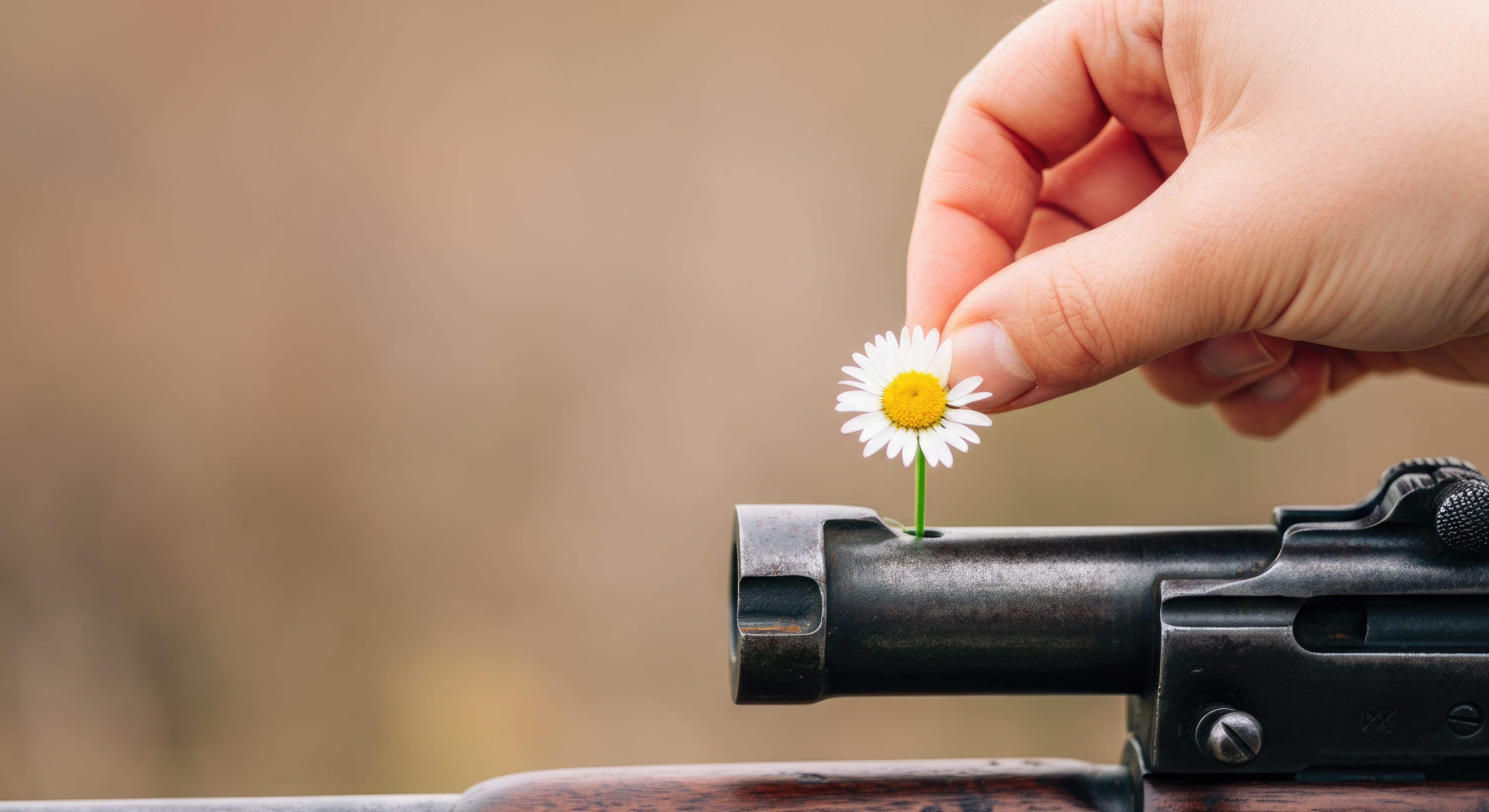
I think empathy is partly innate and partly learned. I also think that empathy can fight against propaganda and deceit espoused by a corrupt leadership. Empathy can fight against the selfish gene. Empathy is the main tool of the Peacemakers.
Peacemakers
So, in my mind, the true warriors of the past and present are the peacemakers. Unfortunately, many of these individuals have been lost to time, while others are little more than a footnote in the history books. There are more Alexander the Greats in the history books than Mahatma Gandhis.
There is a better side to our nature that I would like to think could dominate over the war and violence side.
In his book The Better Angels of Our Nature: Why Violence Has Declined, Steven Pinker, a cognitive scientist, argues that violence has significantly declined over human history, making the present era one of the most peaceful, despite perceptions to the contrary. Pinker attributes this trend to the “better angels” of our nature, like empathy, self-control, reason, and the moral sense. These have been promoted by historical developments such as the rise of democratic governments, literacy, trade, commerce and cosmopolitanism, leading to a reduction in war, homicide, and cruelty.
However, we must keep in mind that this book was written in 2011, before the advent of the Ukraine-Russia War, the recent blowups in the Middle East, in particular Gaza and Iran, and the rapidly developing home-grown 4th Reich, sponsored by the Trump Administration.
Pinker presents data showing a long-term, though not always smooth, decline in violence across various scales, from warfare to domestic abuse. He cites examples like the massive drop in homicide rates in Europe since the Middle Ages, the abolition of slavery, and the end of cruel and unusual punishments.
He identifies four human motivations that counter violence:
Empathy: The ability to understand and share the feelings of others.
Self-control: The capacity to manage impulses.
The moral sense: A sense of fairness and justice.
Reason: The use of logic to see beyond immediate interests.
He argues that historical forces like the growth of states, commerce, literacy, and cosmopolitanism have amplified these “better angels”.
The book challenges the idea that humans are inherently violent and that modernity has made us more violent, suggesting the past was far bloodier.
Erica Chenoweth, known for her groundbreaking research on civil resistance and political violence, is a leading political scientist and professor at the John F. Kennedy School of Government at Harvard University. Her work has shown that nonviolent campaigns are historically twice as effective as armed conflicts, largely due to the “3.5% rule,” which states that no government has withstood a non-violent movement actively mobilizing 3.5% of its population. In this country, that would mean 3.5% of 343,000,000 or 12,005,000.
Chenoweth’s work has fundamentally changed how scholars and activists approach peace-building and political transformation. She co-authored, with Maria J. Stephan, the award-winning book Why Civil Resistance Works, which analyzed 323 major violent and nonviolent campaigns between 1900 and 2006. It revealed that nonviolent movements succeed over 53% of the time, compared to only 26% for violent campaigns.
So, who are some of the most well-known peacemakers throughout history? These would be visionaries, diplomats, and activists who used negotiation, nonviolent resistance, or profound empathy to end conflicts and champion human rights. These individuals dedicated their lives to resolving disputes and healing divided societies.
Modern & 20th-Century Activists
Mahatma Gandhi: Pioneered the philosophy of Satyagraha (nonviolent resistance), which was heavily credited with ending British colonial rule in India.
Martin Luther King Jr.: Led the American Civil Rights Movement, utilizing nonviolent civil disobedience to challenge racial segregation and inequality.
Nelson Mandela: After spending 27 years in prison, he negotiated the end of apartheid in South Africa and fostered national reconciliation as the country’s first Black president.
Mother Teresa: Devoted her life to the destitute and sick, becoming a globally recognized symbol of charity and peaceful coexistence.
Malala Yousafzai: A modern advocate for girls’ education and peace, who survived an assassination attempt by the Taliban to become a champion for oppressed children worldwide.
Diplomats & Thinkers
Bertha von Suttner: An Austrian novelist and the first female recipient of the Nobel Peace Prize. She authored the influential pacifist novel Lay Down Your Arms and convinced Alfred Nobel to establish the prize.
Albert Einstein: Beyond his scientific achievements, he was a vocal advocate for international peace movements and nuclear disarmament following World War I.
Ancient & Indigenous Peacemakers
The Peacemaker (Deganawidah): A legendary figure who, alongside Hiawatha, united five warring Native American tribes (Mohawk, Oneida, Onondaga, Cayuga, and Seneca) to form the Iroquois Confederacy, one of the oldest participatory democracies in the world.
Ashoka the Great: An ancient Indian emperor of the Maurya Dynasty who, after witnessing the horrific casualties of the Kalinga War, renounced violence, converted to Buddhism, and promoted peace and social welfare across Asia.
The legacy of these individuals continues to influence global conflict resolution and human rights.
I am always wondering about our biological tendencies as a species towards greed and war. This was a great article. I would add that the past 30 years of violent video games, the internet, and the age of instant gratification have contributed to aggression in our society.