

In the summer of 2022, after fishing for salmon for a millennium, the Yup’ik communities of St. Mary’s, Alaska, near the confluence of the Yukon River, suddenly found there were no salmon to catch. High Country News quoted community member Serena Fitka as saying, “I could feel the loss,” …I didn’t know what to fill my days with, and I could sense it was like that for everyone along the Yukon River.”
Due to warming waters which impacts salmon early on in their life cycles, and commercial fishing bycatch, chinook numbers have been declining in Alaska for a decade. Then, in 2021, chum populations in the Yukon-Kuskokwim rivers nosedived and have continued to decline ever since, prompting state and federal fishery managers to close chum fishing in those rivers. Each year, the closures have affected more than 2,500 households in a region that relies heavily on chum for subsistence. When chum numbers crashed, High Country News reported that Linda Behnken, the executive director of the Alaska Longline Fishermen’s Association, stated, “the dwindling salmon numbers in the Yukon-Kuskokwim area are a climate justice issue.”
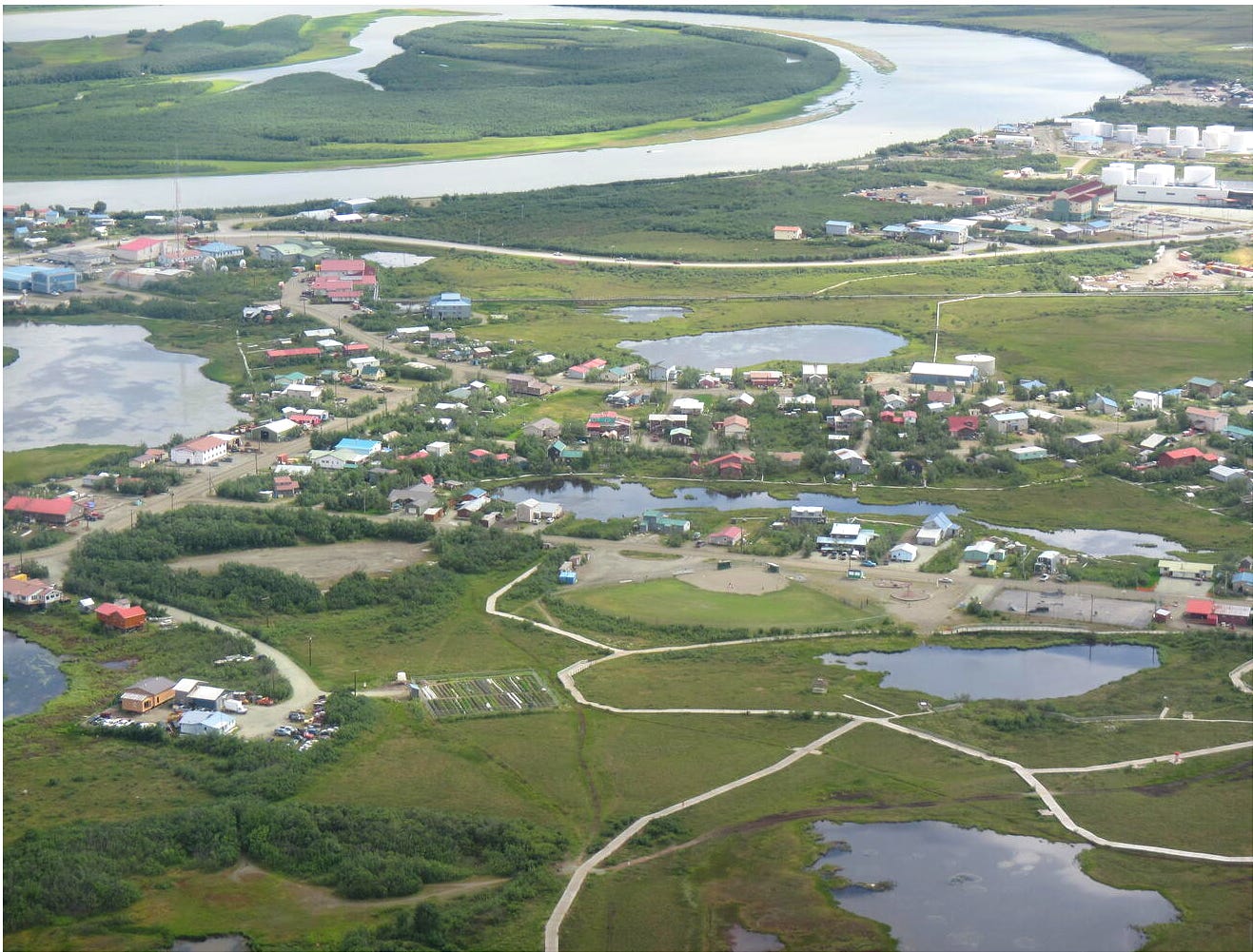
Climate justice, however, is a completely foreign term to the Trump administration. Instead of taking action to address the alarming loss of Alaska’s salmon tradition, for example, Trump through a series of executive orders and regulatory rollbacks, has used the power of the executive office to reverse protections for the State’s water and subsistence resources on a vast scale.
In order to achieve it’s goals, the administration has conveniently denied the existence of climate change. This is despite the fact that as emissions stemming from burning of fossil fuels continue to rise, according to the European Union’s Earth observation service Copernicus, 2024 was the first year that average global temperatures exceeded 1.5C above pre-industrial levels and the Arctic has been the warmest on record over the past 10 years. As part of it’s climate denial, the Trump administration has discarded the Federal Trust responsibility to protect the subsistence resources upon which Alaska Native Tribes rely.
Not surprisingly, Trump’s campaign to exploit Alaska’s natural resources has prompted a kind of feeding frenzy by resource exploitation groups and political leaders who are rushing to get a piece of the action. The Transition Report submitted to the incoming Trump administration by Governor Michael Dunleavy, for example, included a host of measures designed to give the state access to resources and limit environmental analysis or permitting requirements. One of these measures was a request to roll back federal protections of fish habitat and Native Alaskan fishing rights by simply turning over ownership of key salmon rivers running through federal lands such as national parks and national monuments, , instead of going through the legitimate, fact-based process for determining the State’s jurisdiction over such waterbodies.
Because state law requires that subsistence fishing be open to all Alaska citizens, giving the state complete jurisdiction over these waters would eliminate the Rural Subsistence Preference (RSP) under the Alaska National Interest Lands Conservation Act. Because the RSP that rural residents receive a priority when subsistence fishing, in not only protects Alaska Native Fishing rights but it puts less pressure on rapidly depleting salmon populations by simply allowing less people to fish on federal rivers, Nevertheless, the Dunleavy administration’s request prompted the Trump administration to include language in section xxi of the Unleashing Alaska Executive order to transfer regulatory authority over such waters to the State.
Similarly, in May 2025, the Safari Club, a nationwide recreational hunting and fishing lobbying group, filed a Petition for Rulemaking with the Secretaries of the Interior and Agriculture to amend the regulations governing the Federal Subsistence Management Program, the Office of Subsistence Management, and the Federal Subsistence Board (FSB). The petition asks the agencies to reduce the FSB’s seats to only those held by federal agency heads (who are political appointees) and to eliminate all public seats, including the three Tribally nominated seats recently added to the Board.
As in the case of the Dunleavy Administration’s federal lands water grab, because the petition also asks the secretaries to order the FSB to defer to the State of Alaska in setting regulations, this would effectively eliminate the RSP because the Alaska Supreme Court has determined the priority to be unconstitutional under the state constitution, and the State of Alaska cannot legally implement it.
As a result, the petition caused alarm with the Alaska Federation of Natives. According to the Anchorage Beacon, “[i]n a message to members, it called the new proposal ‘a serious threat and a major step backward’ in fish and game management” within Alaska.
The Safari Club has also joined with the Dunleavy Administration’s attacks on the Katie John precedent that confirmed the RSP and that the definition of “public lands” with regard to ANILCA includes those navigable waters in which the United States has an interest by virtue of the Reserved Water Rights Doctrine. After the Ninth Circuit recently affirmed its original decision in Katie John and the U.S. Supreme Court denied an appeal by the state, the Safari Club has been working with the state and the Trump administration to come in through the back door, undermining federal subsistence protections not just on the Kuskokwim but on rivers throughout Alaska.
Alaskans need to stand up to the Trump’s efforts to trod on tribal fishing rights and decimate salmon and those who are taking advantage of such policies for political gain.
Please Submit Comments:
To ensure it considers all aspects of a potential new decision, the Department of the Interior has requested scoping comments on the Safari Club’s petition for rulemaking.
Comments are due by March 30, 2026, and can be submitted by email to
subsistence@ios.doi.gov or through www.regulations.gov, docket number DOI-2025-0170.
Also, DOI will be holding Tribal Consultation sessions on this review with Tribes and Alaska Native Corporations state-wide, in-person and virtually, on March 10 and 17, 2026, at 1:30 - 3:30 p.m.
Thanks for elucidating this very important issue, Hal. It's dismaying and alarming that the current administration has tossed the Federal Trust's responsibility to protect the subsistence resources relied upon by the Alaska Native tribes. I'm grateful you have provided explicit ways Alaskans can protest these activities. By the way, I love the beautiful USGS photo of the Yukon-Kuskokwim Delta Village. What a special, magnificent place! My regards, Marilyn